The Competitive Advantage Is No Longer Better Data — It’s Better Interpretation
Feb 19, 2026
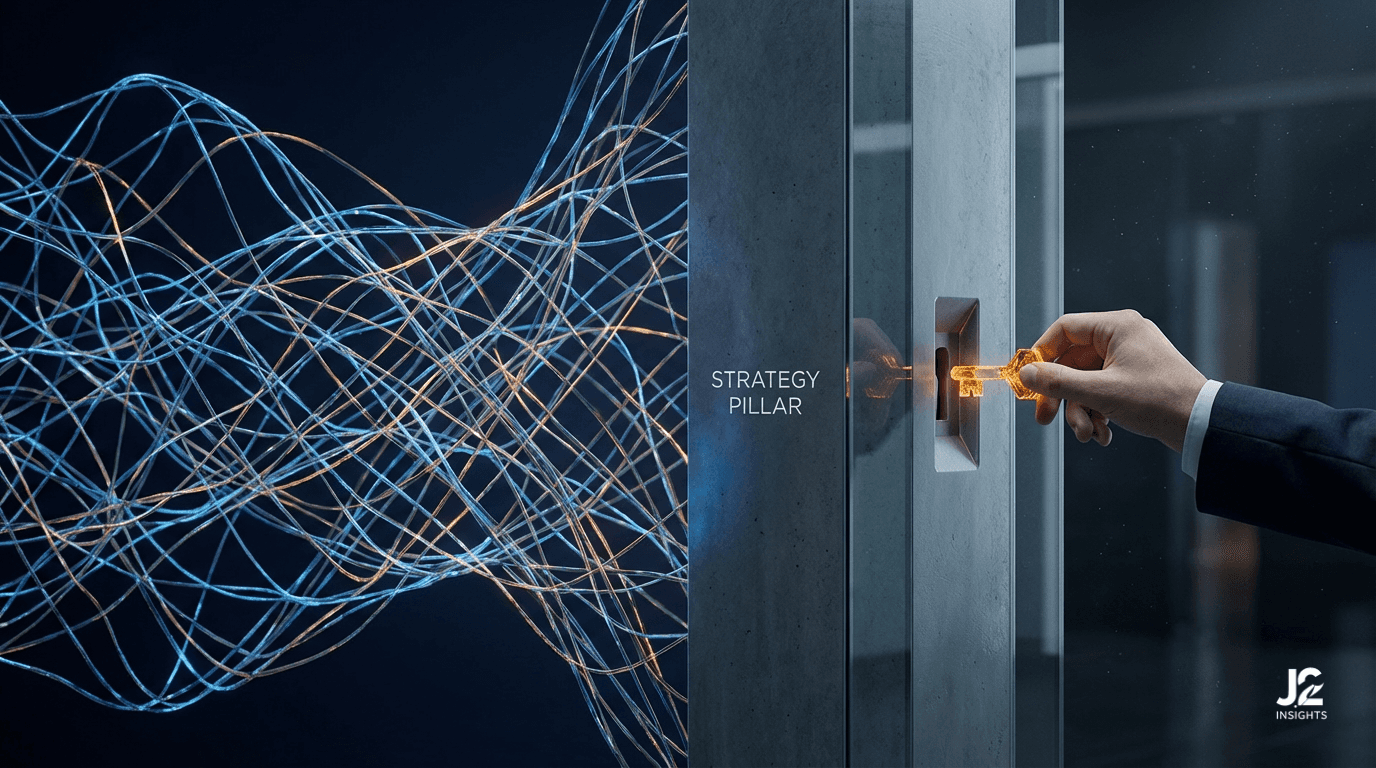
Why AI Elevates Strategic Judgment Instead of Replacing It
In the early days of the digital revolution, the battle was for access. The companies with the largest datasets, the most proprietary "pipes," and the deepest archives held the high ground. But as we move into 2026, data access has commoditized with staggering speed. Through APIs, open-source models, and ubiquitous tracking, everyone has the data.
What differentiates companies now is no longer what they see—it is how they interpret it.
We are moving from an era of "Information Scarcity" to an era of "Insight Density." In this new landscape, the competitive moat isn't built by the algorithm that finds the pattern; it’s built by the human who understands what that pattern means for the P&L.
The Limits of Algorithmic Determinism
AI is a superlative tool for pattern detection, anomaly spotting, and signal aggregation. It can scan millions of rows of consumer behavior and tell you, with mathematical certainty, that a specific segment is migrating from "Product A" to "Product B."
However, what AI cannot do—and what it was never designed to do—is determine commercial relevance. It lacks the "contextual empathy" to know whether a shift in consumer behavior is a permanent structural change or a temporary seasonal blip. It can tell you what is happening, but it cannot tell you so what?
According to the McKinsey Global Institute (2025), the highest-performing organizations aren't those with the "best AI," but those that combine high-velocity analytics with strong interpretive capabilities. These firms outperform their peers not by generating more outputs, but by asking better questions.
The Inversion: Judgment Augmentation
In the legacy market research model, humans spent 80% of their time on "data janitorial" work—cleaning spreadsheets, coding surveys, and building charts. AI has inverted this. Now, the machine does the heavy lifting of data preparation, allowing the researcher to spend 80% of their time on judgment augmentation.
This creates a new workflow for strategic decision-making:
AI Surfaces Patterns: The "signal layer" identifies a sudden shift in EV demand in a specific urban demographic.
Researchers Frame Implications: The human layer interprets this shift through the lens of political shifts, infrastructure delays, and competitor moves that the AI doesn't "know" yet.
Leaders Make Informed Trade-offs: The C-Suite uses this framed insight to decide whether to cut prices, delay a launch, or pivot their marketing narrative.
The future of market research is not algorithmic determinism; it is amplified strategic thinking. AI sharpens the insight, but humans must decide what actually matters.
Extracting Disproportionate Value
At J2 Insights, we believe that "data" is a raw material, much like iron ore. It has no intrinsic value until it is forged into a tool. When two competitors look at the same dataset, the one that can extract a "contrarian" or "structural" insight from that data will win.
This is the core of the "J2" philosophy: Using AI to achieve scale, but using human judgment to achieve Information Advantage. Organizations that understand this balance will extract disproportionate value from the exact same data everyone else has access to.
The 2026 Mandate
As we close this chapter on the future of research, the mandate for leadership is clear: Stop investing in "more data" and start investing in "better interpretation." The next decade won't be won by the most powerful computers, but by the leaders who use those computers to refine their own judgment.
Market research is no longer a department that produces reports; it is the Strategic Filter through which the complexity of the world is made actionable.